Ayesha Fatima is a People Operations leader with experience managing HR across APAC for a global B Corp-certified digital agency operating in over 40 countries. She holds CHRP and SHRM-CP certifications and is currently studying AI governance. Her work spans HRIS administration, employee lifecycle management, performance operations, and multi-country HR compliance.
Executive Summary
AI systems in HR process unprecedented volumes of employee data — performance metrics, communication patterns, engagement indicators, biometric data, and behavioural signals. This article examines the intersection of AI deployment and data privacy law, analyses the specific obligations HR professionals must navigate under GDPR, PIPEDA, and emerging AI regulations, and provides a practical framework for building employee trust in AI-driven people operations.
The Data Expansion Problem
Traditional HRIS systems process structured, transactional data: employment records, compensation, leave balances, performance ratings. AI-enabled HR systems process fundamentally more. They analyse communication patterns to predict engagement. They monitor productivity metrics to inform performance assessments. They evaluate behavioural signals to identify retention risk.
This expansion of data processing raises privacy concerns that existing HR data governance frameworks were not designed to address. When an employee consented to their employer collecting basic employment data, they did not consent to algorithmic analysis of their email response times, meeting attendance patterns, or sentiment analysis of their written communications.
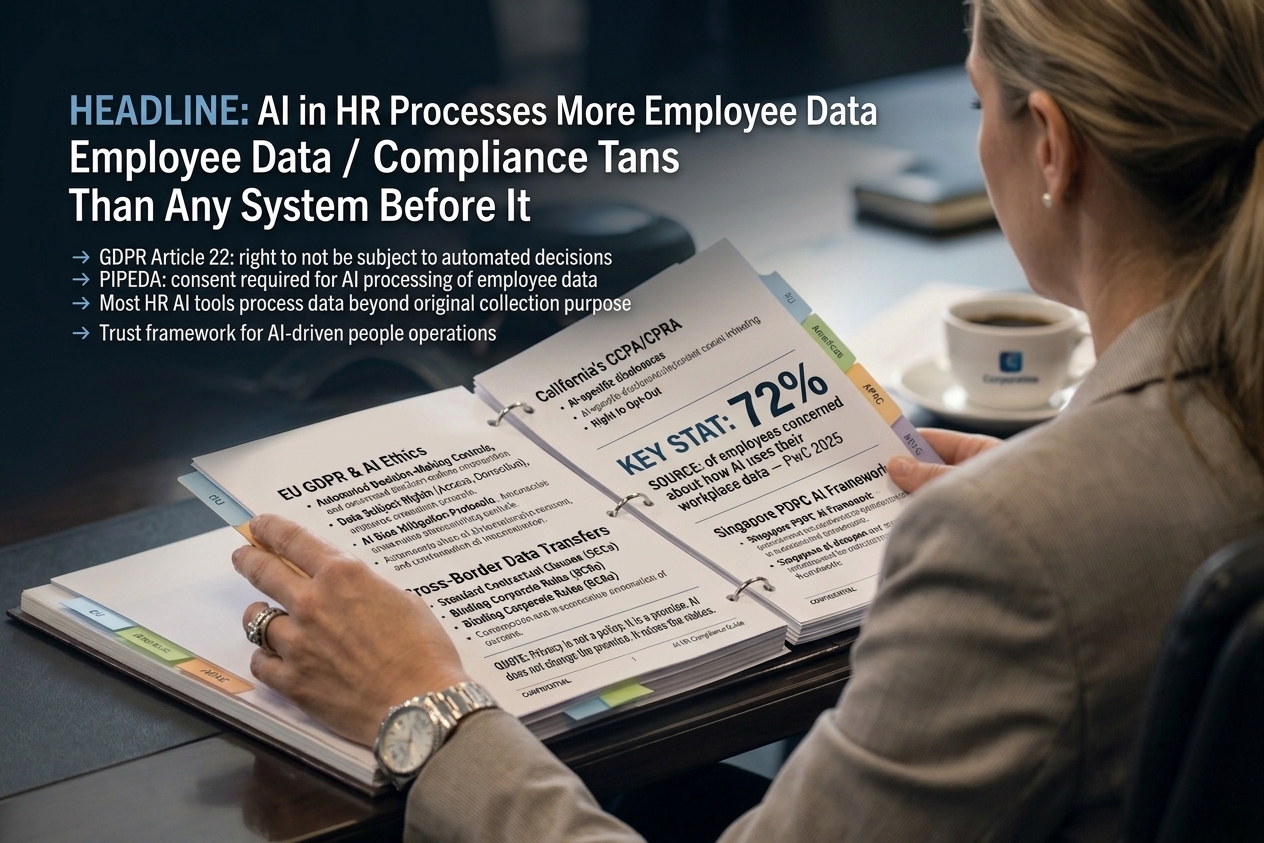
PwC’s 2025 Global Workforce Hopes and Fears Survey found that 72 percent of employees expressed concern about how AI uses their workplace data. This concern is not irrational; it reflects an accurate perception that AI-powered HR tools process data in ways that employees neither understand nor explicitly consented to.
The Legal Framework
GDPR Article 22 establishes a general right not to be subject to decisions based solely on automated processing that produce legal or similarly significant effects. For HR, this means that AI-driven employment decisions — hiring, performance assessment, promotion, termination — require meaningful human oversight and cannot be delegated entirely to algorithms. Data subjects also have the right to obtain an explanation of the logic involved in automated processing and to contest automated decisions.
Canada’s PIPEDA requires that personal information be collected only for purposes that a reasonable person would consider appropriate, that individuals be informed of the purposes, and that consent be obtained. When HR deploys AI tools that process employee data for purposes beyond the original collection purpose — such as using performance data to train a retention prediction model — PIPEDA’s consent requirements may be triggered.
The EU AI Act adds a regulatory layer specifically addressing AI systems. For high-risk AI systems used in employment contexts, the Act requires transparency about the AI system’s purpose and functioning, human oversight mechanisms, and record-keeping that enables post-hoc auditing.
Building the Trust Framework
Privacy compliance is a legal floor, not a ceiling. Building genuine employee trust in AI-driven HR requires going beyond compliance to establish transparency, consent, and accountability as organisational norms. Transparency: communicate clearly and proactively about what data AI systems collect, how it is processed, and what decisions it informs. Use plain language, not legal disclaimers. Consent: where possible, give employees genuine choice about AI-processed data. Where business necessity requires AI processing, explain the necessity honestly. Accountability: establish clear ownership for AI data governance within HR. Ensure employees have accessible channels to raise concerns, request information, or challenge AI-influenced decisions.
The IAPP’s privacy framework provides a structured approach to building these capabilities. Privacy by Design principles — proactive, preventive, and embedded in system architecture — should guide every AI deployment in HR. In my experience across global organisations, the HR teams that invest in privacy governance before deploying AI tools build measurably higher employee trust than those that address privacy reactively after concerns emerge.
Conclusion
AI in HR will process more employee data, in more ways, than any previous system. The legal obligations are clear and tightening. But the real imperative is not compliance; it is trust. Privacy is not a policy. It is a promise. AI does not change the promise. It raises the stakes.
About the Author
Ayesha Fatima is a People Operations leader with experience managing HR across APAC for a global B Corp-certified digital agency operating in over 40 countries. She holds CHRP and SHRM-CP certifications and is currently studying AI governance. Her work spans HRIS administration, employee lifecycle management, performance operations, and multi-country HR compliance.
The views expressed are my own and do not necessarily reflect the views of my employer.
Assisted by AI, reviewed and approved by me.
References
GDPR. (2016). Regulation 2016/679. Art. 22.
PIPEDA. (2000). Canada.
PwC. (2025). Global Workforce Hopes and Fears.
EU AI Act. (2024). Regulation 2024/1689.
IAPP. (2024). Privacy by Design Framework.
Gartner. (2025). Employee Data Privacy Trends.
NIST. (2023). AI RMF 1.0.
Deloitte. (2025). Trust in AI. Global Survey.
Global People Operations Leader with 10+ years of experience across APAC and remote-first organizations. Specializing in Workday, employee lifecycle management, and people-first HR operations. Connect on LinkedIn