Executive Summary
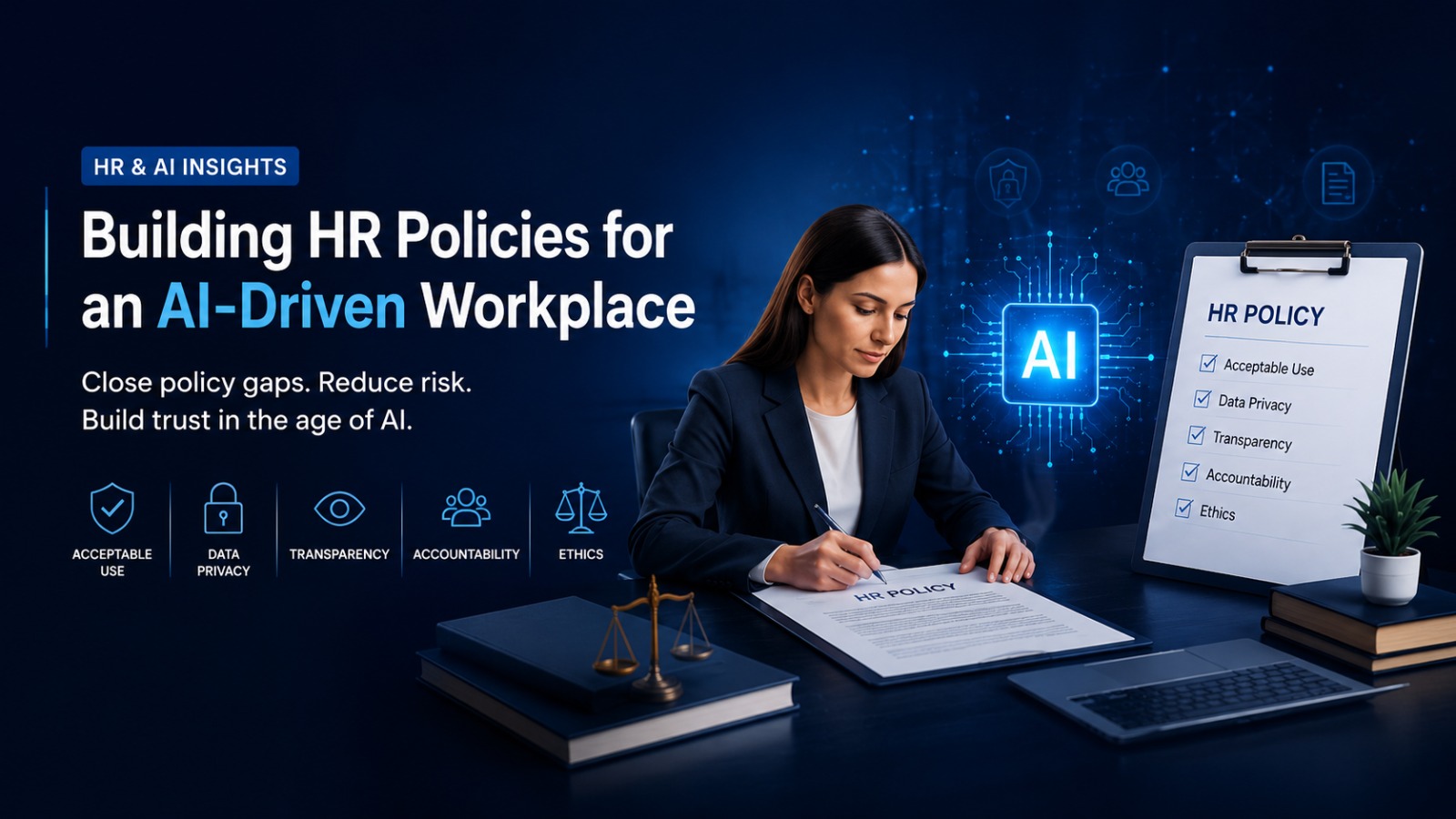
Employee handbooks are the foundational governance documents for the employment relationship. Yet the vast majority of handbooks were written before AI became embedded in workplace operations, employee tools, and HR decision-making systems. This article identifies seven policy areas that most handbooks fail to address, analyses the legal and operational risks of these gaps, and provides practical frameworks for updating employment policies to reflect the realities of an AI-driven workplace.
The Policy Vacuum
AIHR’s 2026 trends research found that 89 percent of HR functions have restructured or plan to restructure within two years, largely in response to AI integration. Yet the policy frameworks governing how AI is used in these organisations have not kept pace. A review of published employee handbook templates from major HR consulting firms reveals that fewer than 15 percent include any provision specifically addressing artificial intelligence.
This policy vacuum creates three categories of risk. Legal risk: without clear AI acceptable use policies, organisations lack defensible boundaries when employee AI use creates compliance issues. Operational risk: without AI disclosure requirements, employees may use AI tools in ways that compromise data privacy, accuracy, or quality standards without organisational awareness. Trust risk: without algorithmic transparency policies, employees affected by AI-driven decisions have no formal channel to understand or challenge those decisions.
The organisations that update their handbooks now are not just managing risk. They are establishing the governance foundation for an AI-enabled workforce.
Seven Policy Areas Your Handbook Needs
Policy Area 1 — AI Acceptable Use: Define which AI tools employees may use for work purposes, which require approval, and which are prohibited. Specify whether employees may use generative AI for client-facing work, internal communications, or decision support. Address the use of personal AI accounts for work tasks and the data privacy implications. This policy should be reviewed and updated quarterly as the AI tool landscape evolves.
Policy Area 2 — AI Disclosure Requirements: Establish clear expectations about when employees must disclose that AI was used in producing work product. This is particularly important in contexts where AI-generated content could affect legal obligations, client relationships, or regulatory compliance. The IAPP’s guidance on AI transparency provides a useful framework for calibrating disclosure requirements to the sensitivity of the context.
Policy Area 3 — Data Privacy in AI Tools: Employee use of AI tools frequently involves inputting data — sometimes sensitive data — into third-party systems. Handbook policies should explicitly prohibit inputting personal data, client data, or confidential business information into AI tools without organisational approval. This extends existing data privacy obligations (under GDPR, PIPEDA, and other frameworks) to the AI context.
Policy Area 4 — Algorithmic Transparency in HR Decisions: When AI systems contribute to decisions about hiring, performance assessment, promotion, or termination, employees should have access to clear information about the role AI played, the data it considered, and the human oversight that was applied. The EU AI Act requires this disclosure for high-risk AI systems; forward-thinking organisations should implement it regardless of jurisdictional requirements.
Policy Area 5 — AI Output Quality and Accountability: AI-generated content can contain inaccuracies, biases, and fabricated information. Handbook policies should establish that employees remain personally accountable for the accuracy and quality of any work product they submit, regardless of whether AI assisted in its creation. The human remains responsible; AI is a tool, not an excuse.
Policy Area 6 — Intellectual Property and AI: Address ownership of AI-generated work product. In most jurisdictions, copyright law does not protect purely AI-generated content. Employees should understand that AI-generated work may not be protectable as intellectual property and that using AI-generated content without disclosure may create legal uncertainty.
Policy Area 7 — AI Ethics and Prohibited Uses: Establish explicit prohibitions on using AI for purposes that violate the organisation’s values, legal obligations, or ethical standards. Examples include using AI to surveil employees beyond legitimate business purposes, using AI to generate misleading information, or using AI to circumvent compliance controls.
Implementation Approach
Updating an employee handbook for AI should not be treated as a one-time revision. The AI landscape changes too rapidly for static policies. Instead, organisations should adopt a modular approach: create an AI Addendum to the handbook that can be revised independently of the broader document. This allows policies to be updated quarterly without requiring a full handbook review cycle.
The development process should involve HR, legal, IT security, and data privacy stakeholders. Employee consultation is equally important; policies developed without input from the people who will be governed by them are more likely to be circumvented or resisted.
In my experience managing policy implementation across multiple APAC markets, the most effective approach is to combine clear written policies with practical training. Employees need to understand not just what the rules are, but why they exist and how to apply them in ambiguous situations that the policy cannot anticipate.
Conclusion
An employee handbook that does not address artificial intelligence is a handbook that is already outdated. The organisations that update their governance frameworks now — establishing clear acceptable use boundaries, disclosure requirements, data privacy protections, and algorithmic transparency standards — will be better positioned to manage the legal, operational, and trust risks that AI integration creates. The policy vacuum will be filled, either by thoughtful organisational governance or by regulatory enforcement. HR professionals should ensure it is the former.
The views expressed are my own and do not necessarily reflect the views of my employer.
Assisted by AI, reviewed and approved by me.
References
AIHR. (2026). HR Trends Report 2026.
EU AI Act. (2024). Regulation 2024/1689.
IAPP. (2024). AI Transparency Guidance.
GDPR. (2016). Regulation 2016/679.
PIPEDA. (2000). Personal Information Protection. Canada.
SHRM. (2026). AI in the Workplace Policy Guidance.
NIST. (2023). AI RMF 1.0.
Gartner. (2026). CHRO Priorities.
Global People Operations Leader with 10+ years of experience across APAC and remote-first organizations. Specializing in Workday, employee lifecycle management, and people-first HR operations. Connect on LinkedIn