Ayesha Fatima is a People Operations leader with experience managing HR across APAC for a global B Corp-certified digital agency operating in over 40 countries. She holds CHRP and SHRM-CP certifications and is currently studying AI governance. Her work spans HRIS administration, employee lifecycle management, performance operations, and multi-country HR compliance.
Executive Summary
The annual performance review is increasingly inadequate for organisations operating in rapidly changing environments. This article examines the shift toward continuous feedback models, analyses how AI can augment performance management without replacing the human conversations that drive growth, and provides a practical framework for implementing continuous growth conversations.
The Case Against Annual Reviews
AIHR’s 2026 trends research highlights the accelerating shift toward continuous feedback. The logic is straightforward: in a world that changes quarterly, a once-a-year backward-looking conversation provides information too late to be actionable. Performance management should be a discipline, not an event.
The most effective performance frameworks centre on two questions: what is going well, and what could make it even better. These questions, repeated frequently across multiple contexts, create a rhythm of feedback that keeps employees aligned, supported, and aware of their trajectory. The frequency matters more than the formality. A two-minute conversation after a presentation generates more developmental value than a two-hour annual review three months later.
AI can augment this process by surfacing relevant data — engagement indicators, goal progress, feedback patterns — that inform the conversation. But AI cannot have the conversation. The trust required for honest developmental feedback is built through human relationship, not algorithmic analysis.
Designing the Continuous Framework
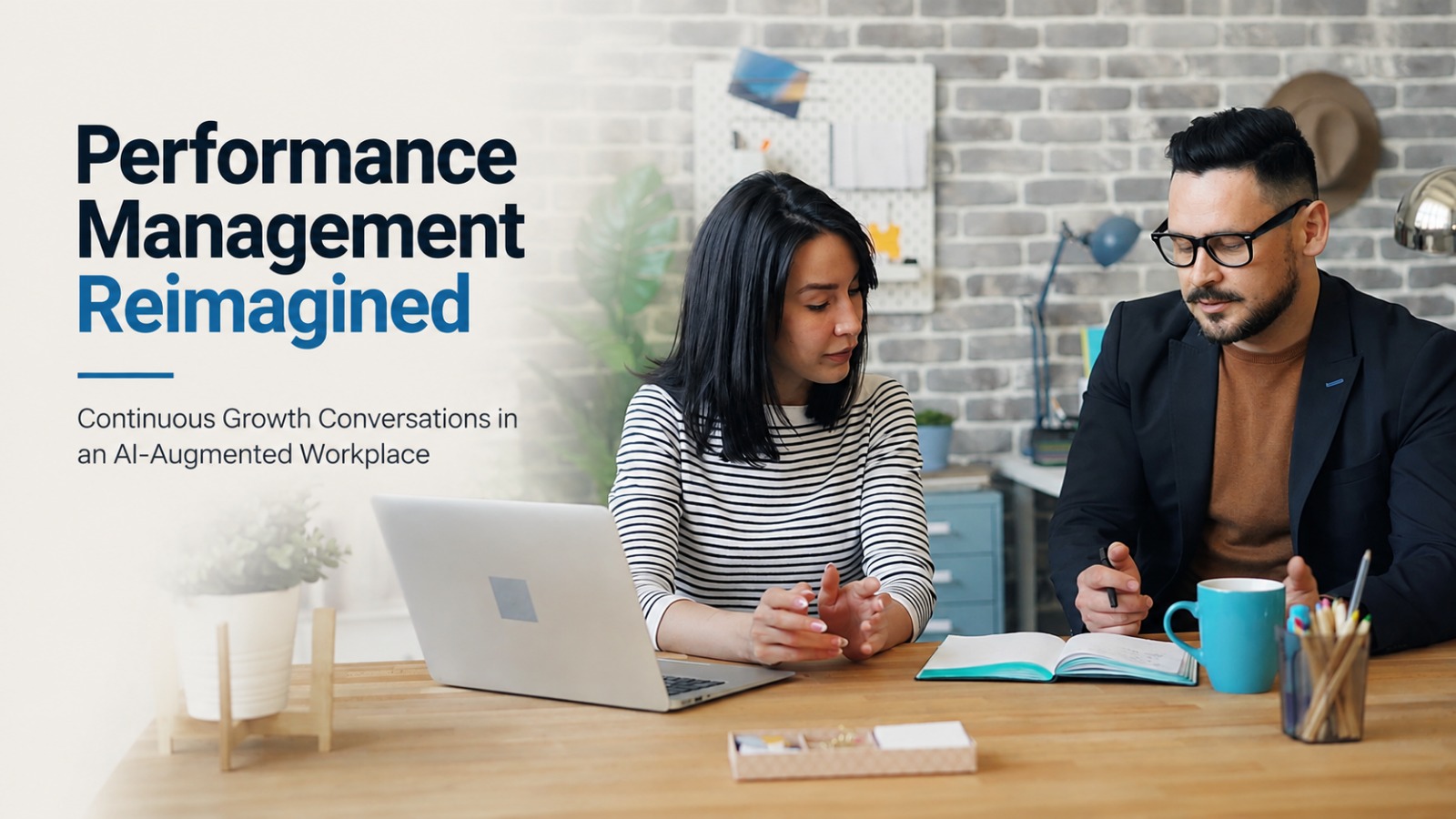
Growth Conversations should be structured around a six-month cadence with informal feedback continuously between formal touchpoints. The semi-annual growth conversation reviews feedback received over the prior six months, recognises achievements, identifies development areas, and sets goals for the upcoming period. These are not rating events; they are development conversations.
Critical design elements include templates for goal-setting that provide structure without constraining, manager accountability for scheduling and conducting conversations, mid-cycle check-ins built into the workflow as mandatory steps, and calibration sessions before any formal ratings to ensure consistency across managers.
In my experience, the most common failure point is the mid-cycle check-in. Organisations that make it optional see it routinely skipped. The most effective designs build it into the workflow as a mandatory step with system-generated prompts and manager accountability tracking.
Conclusion
Performance management reimagined is not a technology transformation. It is a cultural one. AI can provide the data that makes conversations more informed. But the conversation itself — the honesty, the recognition, the challenge, the support — remains irreducibly human. The organisations that build this discipline will develop talent more effectively than any algorithm can identify it.
About the Author
Ayesha Fatima is a People Operations leader with experience managing HR across APAC for a global B Corp-certified digital agency operating in over 40 countries. She holds CHRP and SHRM-CP certifications and is currently studying AI governance. Her work spans HRIS administration, employee lifecycle management, performance operations, and multi-country HR compliance.
The views expressed are my own and do not necessarily reflect the views of my employer.
Assisted by AI, reviewed and approved by me.
References
AIHR. (2026). HR Trends Report.
Gartner. (2026). Performance Management Trends.
Deloitte. (2026). Human Capital Trends.
SHRM. (2025). Feedback and Performance.
CultureAmp. (2025). Performance Review Research.
Global People Operations Leader with 10+ years of experience across APAC and remote-first organizations. Specializing in Workday, employee lifecycle management, and people-first HR operations. Connect on LinkedIn