Executive Summary
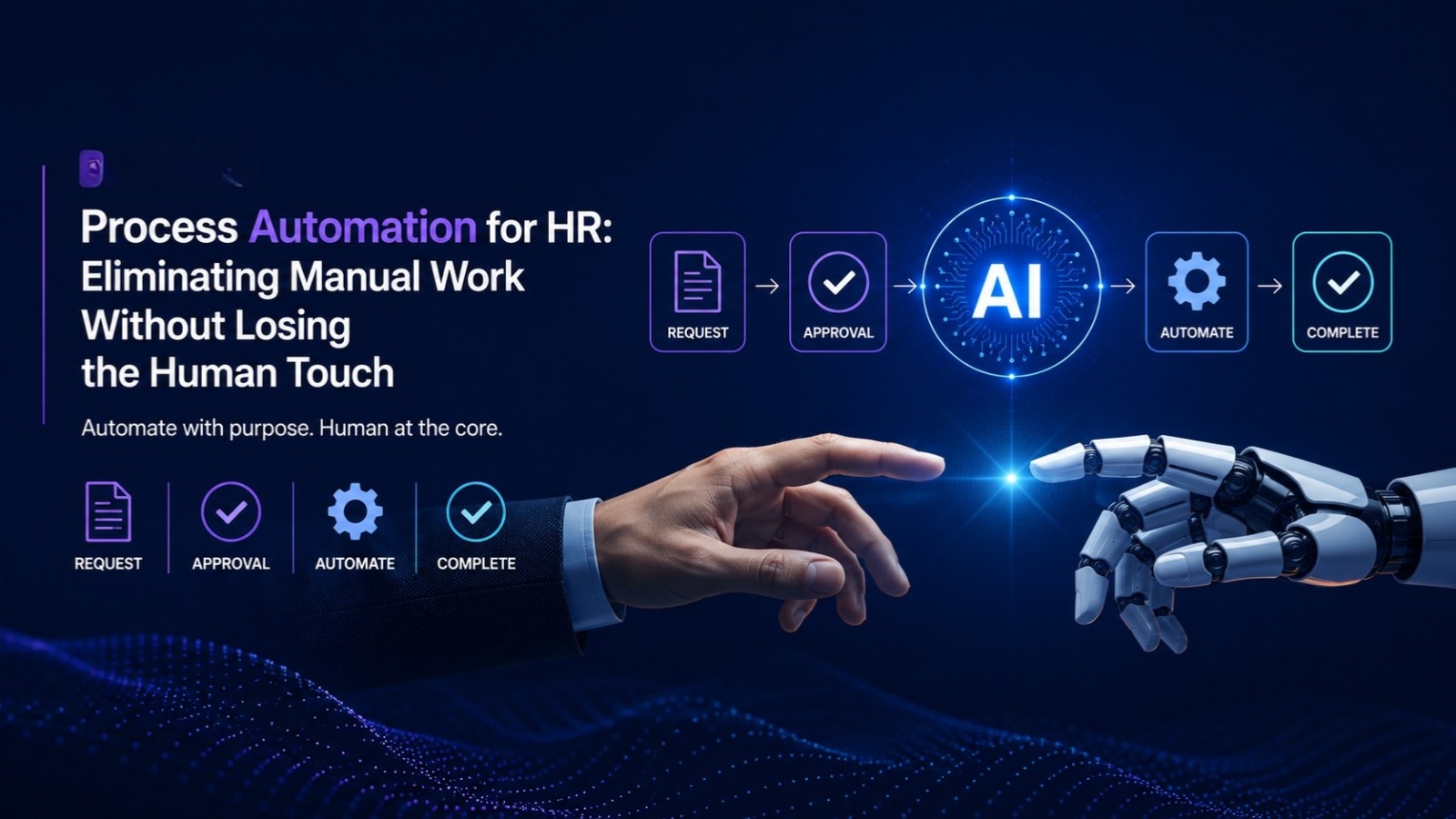
HR process automation promises significant efficiency gains, but poorly designed automation creates new problems: dehumanised employee experiences, compliance gaps in edge cases, and systems that work for standard scenarios but fail in the moments that matter most. This article examines where automation genuinely improves HR operations, where it undermines them, and how to design automated workflows that preserve the human judgment essential to effective people operations.
The Automation Opportunity
The Josh Bersin Company estimates that 30 to 40 percent of HR tasks can be automated with relatively low effort. These tasks share common characteristics: they are repetitive, rule-based, high-volume, and low in contextual complexity. Onboarding document collection, leave balance calculations, standard policy queries, compliance deadline tracking, and routine HRIS data entry all fit this profile.
The operational case is compelling. Every manual step in an HR process is a point of potential error, delay, and inconsistency. When an onboarding checklist depends on a manager remembering to trigger each step, the quality of the new hire’s experience becomes a function of individual memory rather than system reliability. When compliance deadlines depend on calendar alerts that can be dismissed during busy periods, the organisation’s exposure to regulatory risk increases with every missed notification.
Automation addresses these vulnerabilities by making the reliable execution of routine processes independent of individual availability and attention.
Where Automation Fails
The limitations of automation become visible in scenarios that require judgment, empathy, or cultural sensitivity. A leave request that falls outside standard policy parameters. A performance conversation where the employee’s circumstances require nuanced handling. An onboarding experience where the new hire needs reassurance that goes beyond the checklist. A termination process where legal, emotional, and operational considerations intersect.
Research from the Society for Human Resource Management (2025) found that employee satisfaction with HR services is most strongly influenced not by the speed of routine transactions but by the quality of support in non-routine situations. The employee who receives an instant automated response to a standard query but cannot reach a human being when their situation is complex reports lower overall satisfaction than an employee in a slower but consistently human-supported system.
This finding has a clear design implication: automation should handle the predictable so that HR professionals have capacity for the consequential.
A Practical Design Framework
The design question is not what can be automated but what should be. I propose a three-category classification for HR processes. Category 1 — Fully Automate (rule-based, no judgment required): document collection, system access provisioning, leave balance calculations, standard policy query responses, compliance deadline alerts, routine HRIS transactions. Category 2 — Partially Automate (rule-based with exception handling): onboarding workflows with human checkpoints at day 1, day 30, and day 90; leave requests requiring manager approval with automated routing; performance review scheduling with human-led conversations. Category 3 — Never Automate (judgment-intensive, high human impact): performance feedback delivery, employee relations conversations, termination discussions, accommodation requests, career development conversations, conflict resolution.
The boundary between categories is not fixed; it depends on organisational context, cultural norms, and the nature of the workforce. In my experience across global organisations, the most effective approach is to automate the workflow infrastructure while preserving human ownership of every employee-facing interaction where the outcome matters emotionally or legally.
Conclusion
Process automation is one of the most powerful tools available to HR professionals for improving operational quality and freeing capacity for strategic work. But automation without design discipline creates brittle systems that work perfectly for standard cases and fail catastrophically for the edge cases where HR’s value is most needed. The principle is simple: automate the predictable, humanise the consequential. HR professionals who apply this principle will build operations that are both more efficient and more trusted than either a fully manual or fully automated alternative.
The views expressed are my own and do not necessarily reflect the views of my employer.
Assisted by AI, reviewed and approved by me.
References
Josh Bersin Company. (2025). HR Technology Market Analysis.
SHRM. (2025). Employee Satisfaction with HR Services.
Gartner. (2026). HR Technology Trends.
Deloitte. (2026). Human Capital Trends.
AIHR. (2026). HR Trends Report.
McKinsey. (2025). The State of HR Technology Adoption.
Global People Operations Leader with 10+ years of experience across APAC and remote-first organizations. Specializing in Workday, employee lifecycle management, and people-first HR operations. Connect on LinkedIn