Executive Summary
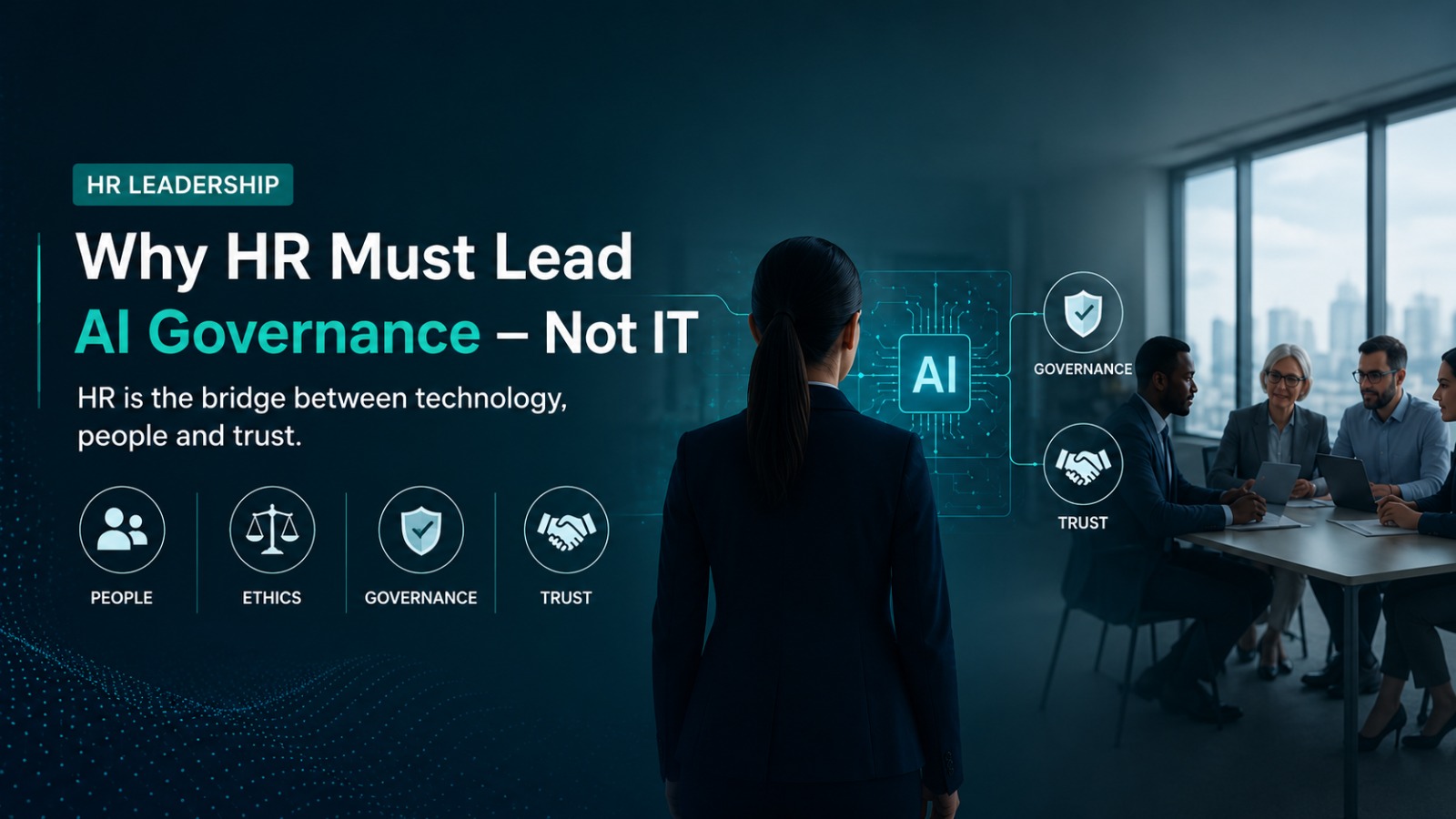
The default organisational response to AI governance has been to assign it to technology teams. This article argues that this approach is structurally flawed for AI systems that affect employment decisions, and that HR professionals possess the regulatory knowledge, human awareness, and operational proximity required to govern AI in the workplace effectively.
The Default Is Wrong
When organisations recognise the need for AI governance, the instinctive response is to assign responsibility to the Chief Technology Officer, the data science team, or the information security function. This instinct is understandable: AI is a technology, and technology governance has traditionally resided with technology teams.
But AI governance in the employment context is not a technology problem. It is a human rights problem, a labour law problem, and a trust problem that happens to involve technology. The distinction matters because it determines who has the expertise to govern effectively.
Gartner’s 2026 CHRO survey found that evolving the HR operating model for AI has the highest predicted impact on AI productivity gains at 29 percent — higher than any technology-led initiative. This finding suggests that the strategic value of AI governance lies not in the technical domain but in the organisational design domain where HR operates.
Three Dimensions of HR’s Governance Advantage
The Regulatory Dimension: HR professionals understand employment discrimination law, data privacy requirements, labour regulations, and the compliance obligations that govern how AI decisions affect employees and candidates. When an AI screening tool produces adverse impact against a protected group, the relevant expertise is not algorithmic tuning; it is Title VII compliance, the four-fifths rule, and the burden of proving business necessity. These are HR and legal competencies, not engineering competencies.
The Human Dimension: HR professionals interact directly with the people affected by AI decisions. They see the candidate who was rejected by an algorithm that could not parse a non-traditional career path. They hear from the employee whose performance rating was influenced by AI monitoring that did not account for the nature of their role. They manage the trust dynamics that AI deployment either strengthens or erodes. This proximity to human impact is a governance capability that technology teams cannot replicate from a distance.
The Operational Dimension: HR professionals administer the systems in which AI is deployed — HRIS platforms, applicant tracking systems, performance management tools, employee support channels. They understand how AI outputs flow into actual employment decisions, where human oversight exists, and where it does not. This operational knowledge is essential for designing governance that works in practice, not just in policy documents.
The Journal of Business Ethics has published research demonstrating that AI governance frameworks designed without domain expertise consistently fail to anticipate the context-specific risks that domain professionals would identify. In the employment context, that domain expertise belongs to HR.
Building the Governance Structure
The practical model is a cross-functional AI governance committee with HR leadership at its centre. The committee should include HR leadership (chair or co-chair), legal counsel, IT and data science, business unit representatives, and where available, external ethics advisors.
HR’s chairing role is justified by the fact that the majority of high-risk AI applications in most organisations — as defined by the EU AI Act — relate to employment and workforce decisions. The function closest to the risk should lead the governance.
The committee’s mandate should include pre-deployment assessment of new AI systems, ongoing bias auditing oversight, employee communication and transparency standards, complaint handling for AI-related concerns, and regular reporting to executive leadership.
The MIT Sloan Management Review has noted that effective AI governance requires not just technical expertise but the ability to translate ethical principles into operational decisions. This translation capability — from principle to practice, from policy to process — is precisely what HR professionals do every day.
The Professional Development Imperative
Leading AI governance requires HR professionals to develop new competencies. Technical literacy — not the ability to build AI systems, but the ability to ask informed questions about how they work, what data they use, and what their limitations are. Regulatory fluency across the emerging patchwork of AI regulations. Risk assessment skills drawn from frameworks like NIST and the IAPP AIGP Body of Knowledge.
These competencies complement rather than replace traditional HR expertise. The HR professional who combines employment law knowledge, cultural sensitivity, and operational experience with AI governance capability becomes one of the most strategically valuable professionals in any organisation.
Deloitte’s 2026 Human Capital Trends report identifies the development of human-AI collaboration skills as a top priority for people leaders. The organisations that invest in building these capabilities within their HR functions now will have a governance advantage that compounds over time.
Conclusion
AI governance in the workplace belongs in HR — not because HR needs to understand the technology better than engineers, but because HR understands the human consequences of AI-driven decisions better than anyone else in the organisation. Technology teams build AI systems. HR builds the trust those systems depend on. The organisations that recognise this distinction and structure their governance accordingly will navigate the AI transition more effectively, more ethically, and with greater employee trust than those that treat AI governance as a purely technical exercise.
The views expressed are my own and do not necessarily reflect the views of my employer.
Assisted by AI, reviewed and approved by me.
References
Gartner. (2026). CHRO Priorities Survey.
EU AI Act. (2024). Regulation 2024/1689.
MIT Sloan. (2025). The Human Side of AI Governance.
Journal of Business Ethics. (2024). AI Governance and Domain Expertise.
Deloitte. (2026). Human Capital Trends.
IAPP. (2024). AIGP Body of Knowledge.
HBR. (2024). Cross-Functional AI Governance.
NIST. (2023). AI RMF 1.0.
Global People Operations Leader with 10+ years of experience across APAC and remote-first organizations. Specializing in Workday, employee lifecycle management, and people-first HR operations. Connect on LinkedIn