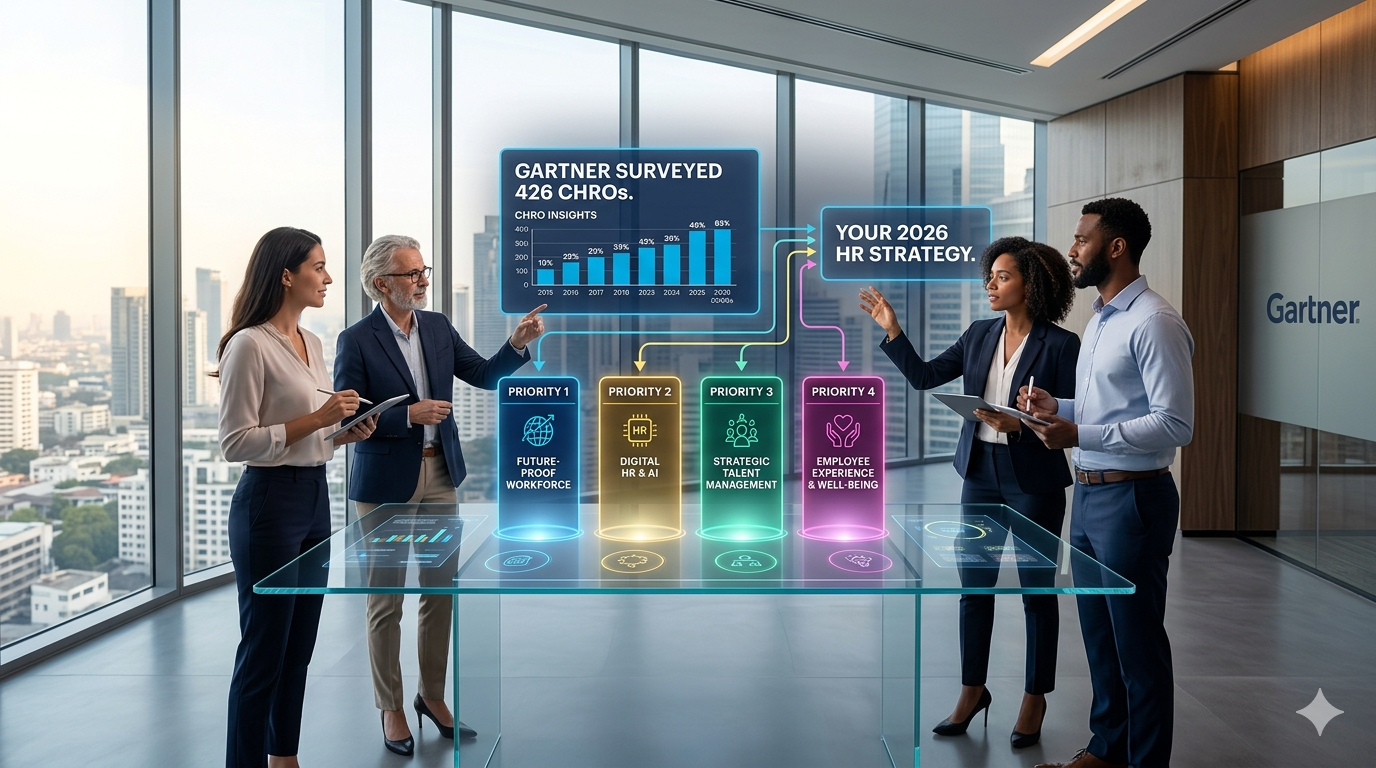
Gartner’s 2026 HR Priorities survey gathered data from 426 Chief HR Officers across 23 industries and 4 global regions. The resulting four priorities are notable not for what they include, but for what they leave out.
None of the top priorities mention traditional HR functions like payroll, benefits administration, or policy compliance. The C-suite is asking HR to be something fundamentally different in 2026.
Priority 1: Harness AI to Revolutionise HR
The most impactful application of AI in HR is not task automation. It is operating model evolution. Gartner found that evolving the HR operating model has the highest predicted impact on AI productivity gains at 29%. This means the biggest AI opportunity is not making HR faster at what it currently does. It is reorganising how HR works entirely.
Priority 2: Shape Work in the Human-Machine Era
The blended workforce where AI handles execution and humans handle judgment — is not a future state. It is the current state for organisations that have moved past pilot phases. HR’s role is to develop talent strategies that account for this reality: which tasks require human judgment, which can be delegated to AI, and how do you help employees navigate the transition?
Priority 3: Mobilise Leaders for Growth During Uncertainty
Most leadership development programmes were built for stability. They trained leaders to plan, optimise, and control. In 2026, the organisations that outperform will be led by people who are comfortable making decisions with incomplete information, communicating uncertainty without creating panic, and deploying resources quickly rather than perfectly.
Priority 4: Embed Culture to Drive Performance
Culture is often treated as a communications exercise. Gartner’s framing positions it as a performance driver. The distinction matters. Culture is not what the values poster says. It is what the performance system rewards, what the promotion criteria reinforce, and what the organisation tolerates from its highest performers.
What This Means for HR Professionals
The gap between what the C-suite expects from HR and what most HR functions are currently structured to deliver is significant. Closing that gap requires investment in capabilities that many HR teams are still developing: AI literacy, data interpretation, strategic workforce planning, and the confidence to lead organisational change rather than just support it.
The Gartner data is not a set of aspirations. It is a signal of what the most senior HR leaders globally have identified as the work that matters most right now.
Global People Operations Leader with 10+ years of experience across APAC and remote-first organizations. Specializing in Workday, employee lifecycle management, and people-first HR operations. Connect on LinkedIn