Artificial intelligence is reshaping every dimension of human resources from how organisations source talent to how they manage performance and process employee data. Yet the governance frameworks required to deploy AI responsibly in HR remain underdeveloped in most organisations. This article examines the regulatory landscape, analyses why HR professionals are uniquely positioned to lead AI governance, and provides a practical framework for People Operations leaders.
The Governance Gap
The adoption of artificial intelligence in human resources has accelerated beyond the capacity of most organisations to govern it responsibly. A 2026 SHRM survey of 1,908 HR professionals found that while AI tools are increasingly embedded in recruitment, performance management, and employee support functions, 54 percent of organisations have not adopted any formal AI governance framework and have no plans to implement one.
This governance gap is not merely a compliance risk. It is a trust risk. When AI systems influence decisions about who gets hired, who gets promoted, and who gets terminated, the absence of clear governance structures means that employees, candidates, and regulators are left without assurance that these decisions are fair, transparent, and accountable.
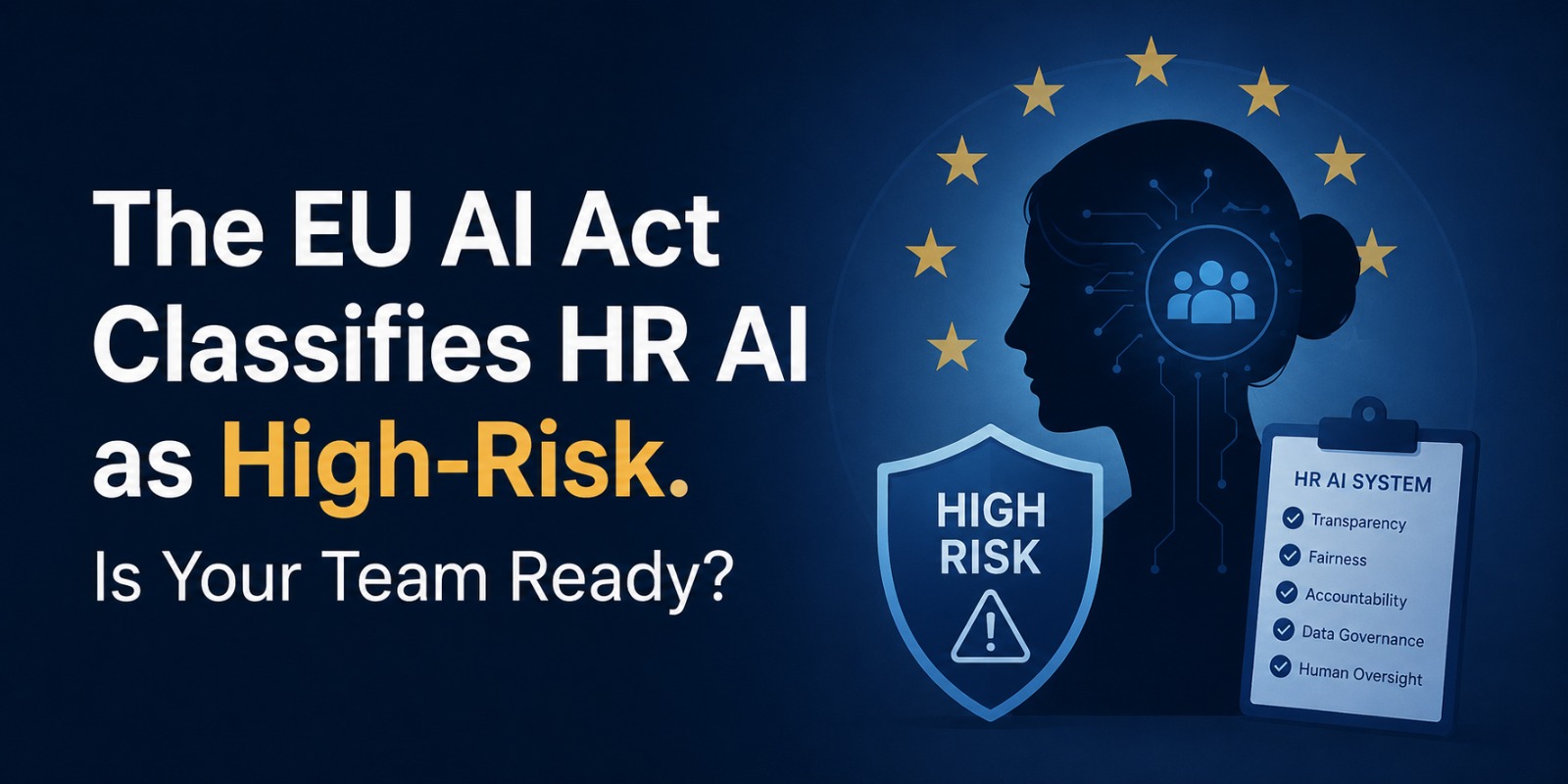
The regulatory environment is accelerating to fill this vacuum. The European Union’s Artificial Intelligence Act, which entered into force in August 2024 with phased implementation through 2027, represents the most comprehensive AI regulation in the world. It classifies AI systems used in employment and workforce management as high-risk a designation that carries significant compliance obligations including conformity assessments, human oversight requirements, transparency obligations, and detailed record-keeping.
For HR professionals, the EU AI Act is not a distant European concern. Any organisation that employs people in EU member states, processes EU residents’ data, or deploys AI tools developed by EU-based vendors falls within its scope. In practice, this encompasses the majority of multinational organisations and a significant proportion of the global HR technology vendor ecosystem.
The Regulatory Landscape
The EU AI Act establishes a risk-based classification framework for AI systems. Systems used in employment contexts including recruitment and selection, task allocation, performance monitoring, and termination decisions are classified as high-risk under Annex III. This classification applies to any AI system used for these purposes within the Act’s jurisdictional scope. High-risk systems are subject to conformity assessments, human oversight measures, employee notification requirements, and fundamental rights impact assessments. The penalties for non-compliance reach up to 35 million euros or 7 percent of annual global turnover.
Beyond Europe, the US Equal Employment Opportunity Commission issued guidance clarifying that employers remain liable for disparate impact discrimination caused by AI tools, even when those tools are provided by third-party vendors. The NIST AI Risk Management Framework provides a voluntary but influential governance structure organised around four functions: govern, map, measure, and manage. Canada’s proposed Artificial Intelligence and Data Act, regulatory frameworks emerging in Singapore, Brazil, and Australia all signal that AI governance is becoming a global imperative.
The International Association of Privacy Professionals has established the AI Governance Professional certification, recognising that AI governance is becoming a distinct professional competency sitting at the intersection of technology, law, ethics, and human resources.
Why HR Must Lead AI Governance
In most organisations, AI governance has been delegated to IT or data science teams. This is a structural error. Technology teams evaluate technical performance: accuracy, latency, computational efficiency. They are not typically equipped to evaluate the human impact of AI-driven employment decisions.
Whether an AI screening tool produces disparate impact on protected groups is a civil rights question. Whether an AI performance monitoring system undermines employee trust is an organisational psychology question. Whether an AI-generated termination recommendation complies with local labour law across multiple jurisdictions is a legal and HR compliance question.
The Harvard Business Review has argued that effective AI governance requires cross-functional governance structures that include domain experts, ethicists, legal counsel, and those closest to the human impact of AI decisions. In the employment context, that means HR.
In my experience across global organisations managing people operations for distributed teams across multiple markets, the HR function bridges three critical governance dimensions. The regulatory dimension: HR professionals understand employment law, anti-discrimination requirements, and data privacy obligations. The human dimension: HR professionals interact directly with the people affected by AI decisions. The operational dimension: HR professionals administer the systems in which AI is deployed and understand how AI outputs flow into actual employment decisions.
A Practical Framework for HR-Led AI Governance
Based on the EU AI Act, the NIST framework, the IAPP AIGP Body of Knowledge, and the practical realities of managing AI in multi-country HR operations, I propose a five-component governance framework.
1. AI Inventory and Risk Classification: Identify every AI system in HR operations. Most organisations do not have a complete inventory. AI capabilities are often embedded in vendor platforms, activated by default without formal organisational awareness. The inventory should catalogue each system, its purpose, the data it processes, the decisions it influences, and the vendor’s transparency. Each system should be classified against the EU AI Act’s risk framework.
2. Bias Auditing and Fairness Assessment: The EEOC’s guidance is unambiguous: employers are responsible for discriminatory impact of AI tools they use, regardless of whether bias originates in the employer’s data or the vendor’s algorithm. Bias auditing should examine AI outputs for disparate impact across protected characteristics. Research published in FAccT proceedings has consistently demonstrated that AI systems trained on historical data reproduce and amplify existing patterns of bias.
3. Transparency and Employee Communication: The EU AI Act requires individuals be informed when AI systems are used in decisions affecting them. HR professionals should develop clear communications explaining where AI is used, what role it plays, what human oversight exists, and how individuals can raise concerns. Transparency is not a compliance checkbox. It is the foundation on which employee trust in AI-driven HR is built.
4. Human Oversight Design: Meaningful human oversight requires that the human reviewer has sufficient information, training, and authority to override the AI’s output. The MIT Sloan Management Review has noted that automation bias the tendency to defer to algorithmic recommendations is one of the most significant risks in AI-assisted decision-making. Governance frameworks must explicitly counteract this tendency.
5. Governance Structure and Accountability: Establish a cross-functional AI governance committee including HR leadership, legal counsel, IT, and business stakeholders. HR should chair or co-chair this committee, given that the majority of high-risk AI applications relate to employment decisions. Gartner’s 2026 CHRO research identifies AI governance as one of the four highest-priority areas for chief HR officers globally.
Implications for Professional Development
The SHRM competency framework and the CHRP body of knowledge are both evolving to incorporate AI-related competencies. The IAPP’s AIGP certification provides a structured learning pathway covering regulatory frameworks, risk assessment, ethical principles, and governance structures. SHRM’s 2026 research found that 54 percent of HR professionals believe AI upskilling will have high impact, yet only 1 percent have implemented formal training. This gap between awareness and action represents both a risk and an opportunity for HR professionals who invest in AI governance competency now.
Conclusion
AI governance in HR is not a future challenge. It is a present obligation. The EU AI Act is in force. The EEOC’s guidance is operative. Employees are watching to see whether their organisations govern AI influence responsibly. HR professionals are uniquely positioned to lead this governance not because they understand the technology better than engineers, but because they understand the human consequences of AI-driven decisions better than anyone else in the organisation. The question for every HR professional is not whether AI governance matters. It is whether you are prepared to lead it.
References
- European Parliament. (2024). Regulation (EU) 2024/1689 (AI Act). OJ EU.
- SHRM. (2026). State of AI in HR: 2026 Survey. SHRM Research.
- EEOC. (2023). Assessing Adverse Impact in AI Employment Selection.
- NIST. (2023). AI Risk Management Framework 1.0. NIST AI 100-1.
- IAPP. (2024). AIGP Body of Knowledge.
- Gartner. (2026). Top Priorities for HR Leaders. 426 CHROs surveyed.
- Raghavan et al. (2024). Mitigating Bias in Algorithmic Hiring. FAccT Proceedings.
- Tambe, Cappelli & Yakubovich. (2019). AI in HRM. California Management Review, 61(4).
- HBR. (2024). Building Cross-Functional AI Governance.
- MIT Sloan. (2025). The Human Side of AI Governance.
Global People Operations Leader with 10+ years of experience across APAC and remote-first organizations. Specializing in Workday, employee lifecycle management, and people-first HR operations. Connect on LinkedIn